

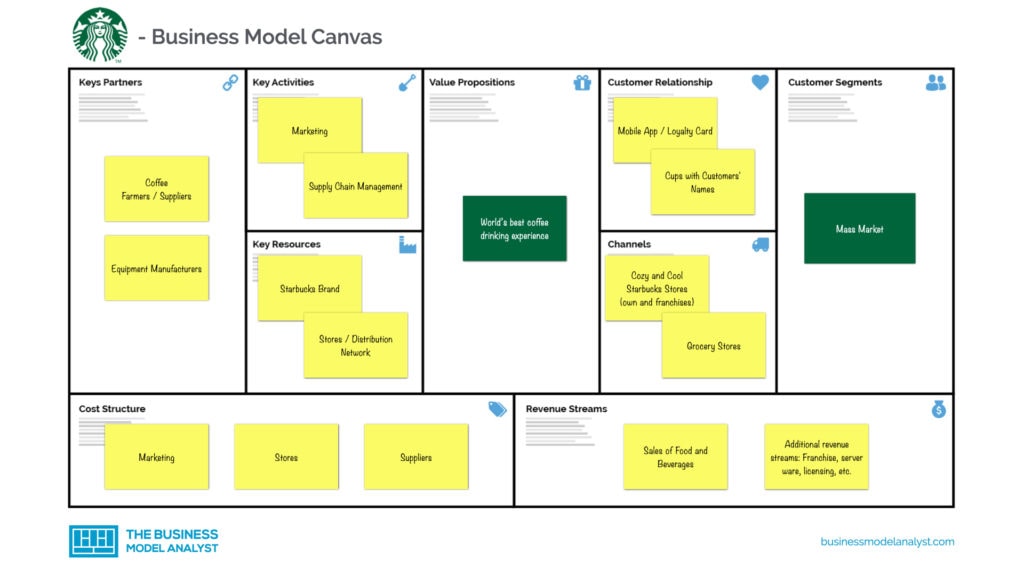
The business model canvas is a great tool to help you understand a business model in a straightforward, structured way. Using this canvas will lead to insights about the customers you serve, what value propositions are offered through what channels, and how your company makes money
A business model is simply a plan describing how a business intends to make money. It explains who your customer base is and how you deliver value to them and the related details of financing. And the business model canvas lets you define these different components on a single page. The business model canvas is a strategic management tool that lets you visualize and assess your business idea or concept. It’s a one-page document containing nine boxes that represent different fundamental elements of a business.
- Customer Segments.
- Customer Relationships.
- Channels.
- Revenue Streams.
- Key Activities.
- Key Resources.
- Key Partners.
- Cost Structure.
The Starbucks story begins with three students at the University of San Francisco, back in the early 1970s: the English teacher Jerry Baldwin, the history teacher Zev Siegl, and the writer Gordon Bowker. The three of them had met Alfred Peet, a coffee roasting entrepreneur, who taught them his style of roasting beans.
After that, they decided to sell high-quality coffee beans and equipment. Before the foundation, Bowker owned an advertising agency with Terry Heckler, who said that words beginning with “st” were powerful. So, the founders looked up a list of words beginning with “st,” and discovered a mining town called “Starbo”. From there, they recalled the name of the chief mate in Moby-Dick’s book: “Starbuck”. And that was how the first Starbucks was born, on March 31, 1971, in Seattle, Washington.
Starbucks’ Mission Statement
To inspire and nurture the human spirit — one person, one cup, and one neighborhood at a time.
Starbucks’ Values
- Creating a culture of warmth and belonging, where everyone is welcome;
- Acting with courage, challenging the status quo, and finding new ways to grow our company and each other;
- Being present, connecting with transparency, dignity, and respect;
- Delivering our very best in all we do, holding ourselves accountable for results.
Starbucks’ Channels
Coffee shops, grocery stores, retailers, Starbucks cards, customer service, Starbucks apps, and social media.
Starbucks’ revenue by product types
- Beverages: The majority of Starbucks revenue comes from the sale of beverages (around 60%), especially coffee ones;
- Food: Food is the second-highest revenue source, standing for 18% of the total generated;
- Packaged and single-serve coffees & teas: Revenues generated from these products are the lowest, representing 8% of the total;
- Others: 14% of the total revenue comes from royalty & licensing, selling beverage-related ingredients, server ware, and ready-to-drink beverages.
There is no customer segmentation in Starbucks’ business model. Anyone who wants high-quality coffee is part of Starbucks’ customer segment. In other words, the mass market.
Starbucks’ Value Propositions
- Innovation: Starbucks constantly designs innovative products for its customers;
- Quality: It uses only high-quality beans and trained roasters to work on them;
- Convenience: Customers can order products through Starbucks’ app, avoiding lines at the stores;
- Variety: It offers 30 blends of coffee and a wide range of sandwiches, pastries, tea, smoothies, salads, etc.;
- Brand: Starbucks has a powerful and awarded brand, seen as a synonym of quality.


